



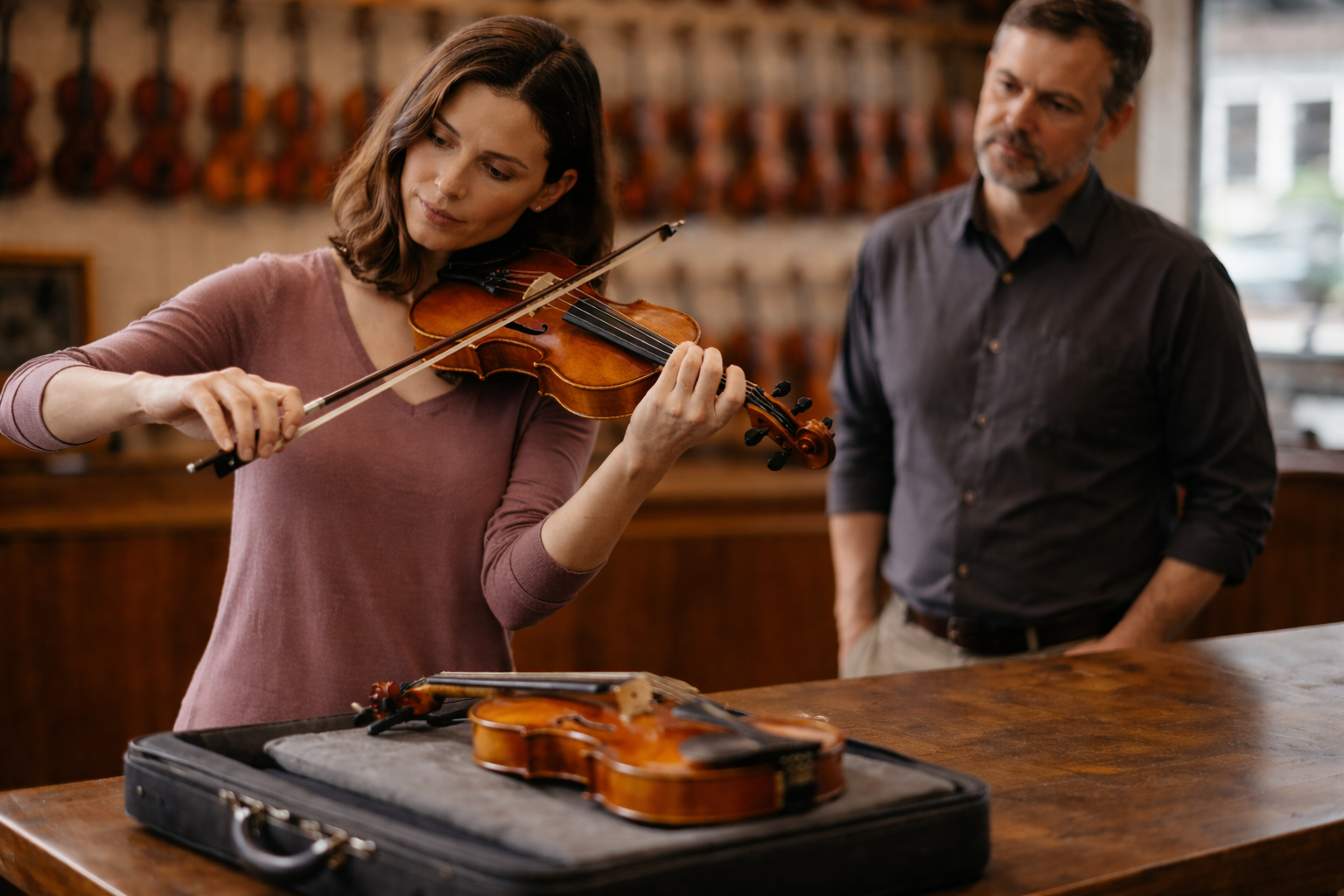
Buying a string instrument online without playing it first is possible, but it is not the safest standard. For players who care about sound, response, and long-term progress, evaluating an instrument in person remains the most reliable way to make a confident decision.
At Von’s Violin Shop, this question comes up most often from advancing players who already understand that instruments are not interchangeable objects. Two violins that look nearly identical on a screen can behave very differently once they are under the bow. The reasons for that difference explain why in-store comparison remains the gold standard.
Why Playing the Instrument Matters
String instruments are not standardized products. Each one has its own balance, response, and tonal behavior. These differences cannot be fully communicated through photographs, measurements, or written descriptions.
When you play an instrument in person, you are evaluating factors that cannot be reduced to specifications. You are feeling how quickly the instrument speaks when the bow touches the string. You are hearing how the tone changes as you vary bow speed and pressure. You are noticing how the instrument responds in higher positions and across different strings.
These are the characteristics that determine whether an instrument supports or limits your playing. Without physically playing the instrument, those characteristics remain unknown.
What Online Buying Can and Cannot Do
Buying online can reduce some risks if certain protections are in place, such as return periods or approval windows. Those measures exist because sellers recognize the inherent uncertainty of buying without playing.
However, even with those protections, the evaluation still happens after the instrument arrives. That means the burden shifts to the buyer to identify issues, compare instruments, and decide whether the instrument truly fits their needs.
For experienced players, this can be workable. For newer or advancing players, it often creates uncertainty. If you do not yet know what a responsive instrument feels like, it can be difficult to determine whether the problem lies with your technique or the instrument itself.
In-store evaluation removes that ambiguity.
Setup Is Necessary, But Not Sufficient
Professional setup is essential for any instrument to perform correctly. Proper bridge fitting, soundpost placement, fingerboard shaping, nut work, and string selection all matter.
However, setup does not eliminate differences between instruments. A well-made instrument with proper setup will still behave differently from another well-made instrument with proper setup. Construction, materials, and craftsmanship continue to matter after setup is complete.
Even the best setup cannot turn a poorly made instrument into a responsive one. At the same time, a fine instrument that has been under tension for many years without being played may need adjustment or repair before it shows its true character.
This is why evaluating instruments in person, after they have been inspected and prepared, remains the safest approach.
Why In-Store Comparison Is Different
When you compare instruments in person at Von’s Violin Shop, you are controlling variables that cannot be controlled online.
You are playing instruments back-to-back in the same room. You are using the same bow. You are hearing how each instrument responds to the same musical material. Differences become immediately apparent.
This kind of comparison allows players to make fair judgments. Instead of wondering whether an instrument would sound better in a different space or with different conditions, you hear and feel the difference directly.
It also allows experienced staff to listen and provide context. Often, a player hears that one instrument feels “easier” or “more open” but cannot yet articulate why. In-store guidance helps translate those impressions into meaningful decisions.
Why In-Store Is Safer for Advancing Players
As players progress, their sensitivity to instrument behavior increases. Subtle differences in response, balance, and tonal flexibility become more important.
At this stage, choosing an instrument without playing it first introduces unnecessary risk. Even if the instrument can be returned, the process adds friction and uncertainty. It also makes direct comparison difficult, especially if multiple instruments are not available at the same time.
In-store evaluation minimizes those risks by letting the player make decisions based on direct experience rather than expectations.
What Von’s Violin Shop Does Differently
At Von’s Violin Shop, every instrument is inspected by a Luthier to ensure it meets real playing standards. Instruments are evaluated as musical tools, not decorative objects.
This means that when you play an instrument in the shop, you are hearing what it is capable of under normal conditions. You are not compensating for unresolved setup issues or hidden problems.
The goal is not to rush a decision. It is to help players understand what they are hearing and feeling so they can choose an instrument that supports their current level and future growth.
The Safest Standard
Buying an instrument online without playing it first can work under certain conditions, but it introduces variables that do not exist when you play in person. The safest standard remains evaluating instruments directly, under consistent conditions, with experienced guidance available.
For players who are ready to move beyond their first instrument or invest in a higher quality one, that standard matters.
If you have questions about comparing instruments or want to understand what differences to listen and feel for, Von’s Violin Shop and Northland Violins are always available to help. Playing the instrument first is not just safer. It is how confident decisions are made.