



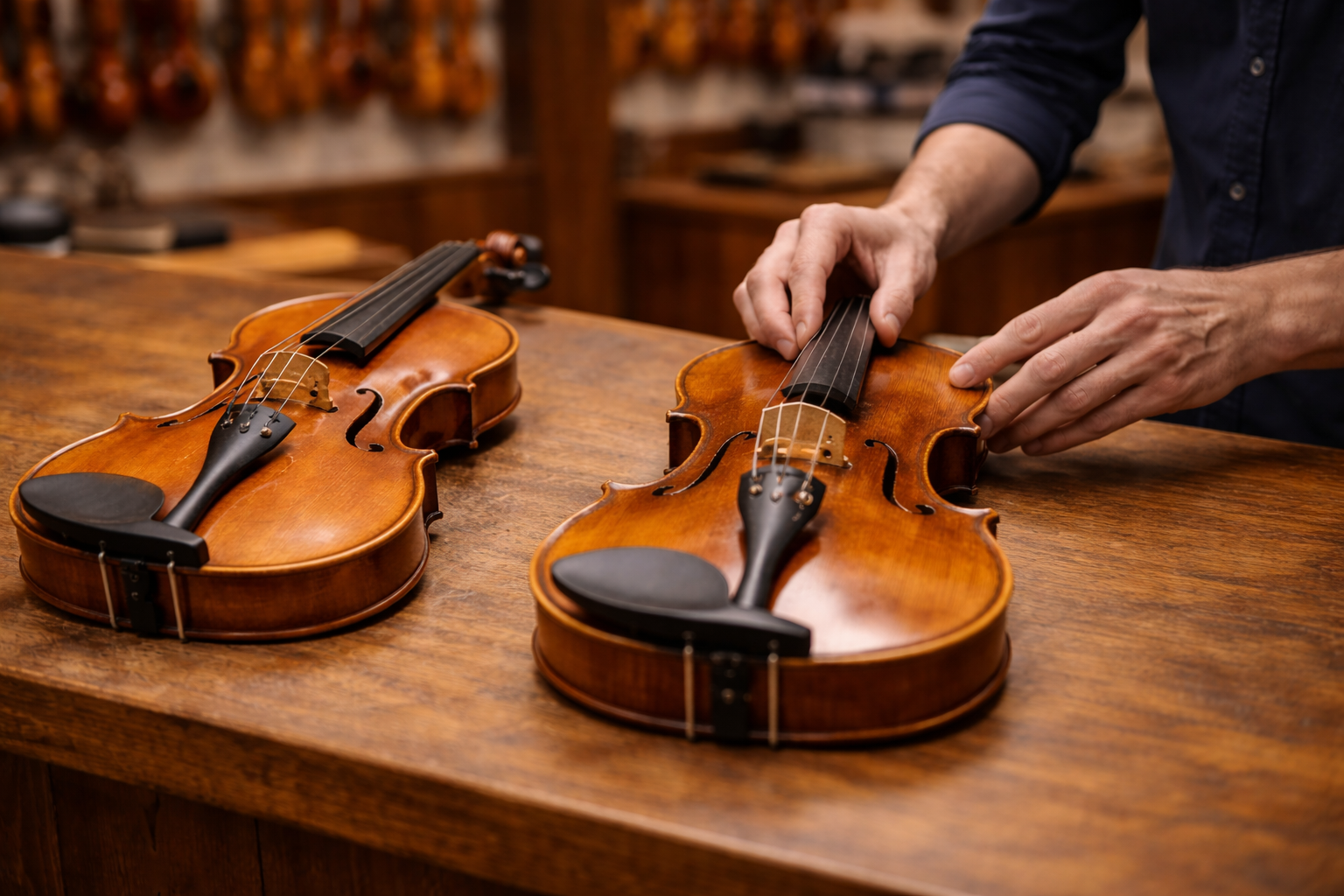
If you are new to stringed instruments, you may not have heard the term “violin-shaped object” or VSO. It sounds like an exaggeration, but it describes a very real problem. A violin-shaped object looks like a violin, is often marketed as a violin, but does not function as one in any meaningful musical sense.
For beginners, parents, and adult learners alike, VSOs are one of the biggest obstacles to success. They are frustrating to play, difficult or impossible to tune, and can actively discourage a new player from continuing. Understanding how to avoid them can save time, money, and a great deal of disappointment.
What Is a Violin-Shaped Object?
A violin-shaped object is an instrument that resembles a violin in appearance but lacks the materials, construction, and setup required to play properly. These instruments are often produced as cheaply as possible, with little regard for tone, structural stability, or playability.
They are not simply “lower quality violins.” They are instruments that were never truly playable to begin with and in fact should not be called instruments. They are decorations.
At Von’s Violin Shop, the term is used very deliberately. A violin-shaped object is something the shop would never sell, because it does not meet the basic standards required for a functional string instrument.
Why Violin-Shaped Objects Are a Problem
For a beginner, everything about learning a string instrument is already challenging. Proper posture, bow control, intonation, and tone production all take time to develop. A violin-shaped object adds unnecessary difficulty.
Common problems include:
- Pegs that slip or seize, making tuning difficult, or impossible
- Bridges that are poorly shaped or improperly positioned
- Fingerboards that are uneven or incorrectly angled
- Poor string height that causes discomfort or buzzing
- Weak construction that cannot hold tension properly
When an instrument fights the player at every step, progress slows or stops entirely. Beginners often assume the difficulty is their fault, when in reality the instrument is the problem.
Why Price Alone Is Not a Reliable Indicator
Many people assume that avoiding VSOs is simply a matter of avoiding very cheap instruments. While price can be a clue, it is not a guarantee.
Some poorly made instruments are sold at surprisingly high prices by sellers who rely on marketing language rather than craftsmanship. Conversely, well-made student instruments can sometimes be found at reasonable prices when sold by knowledgeable shops that specialize in string instruments.
The difference lies not just in cost, but in how the instrument was built, inspected, and set up.
What to Look For
You do not need to be a luthier to spot red flags. Even at a high level, there are clear indicators that separate playable instruments from violin-shaped objects.
A real violin should feel stable and solid in your hands. The neck should feel straight and comfortable, not twisted or awkward. The pegs should turn smoothly and hold their position without slipping back.
The bridge should stand upright, fit the top of the violin cleanly, and not appear warped or roughly cut. The strings should sit at a height that feels manageable, not painfully high or buzzing against the fingerboard.
If an instrument feels unpredictable, fragile, or difficult before you even play a note, that is a warning sign.
Simple Playability Tests Anyone Can Do
Even beginners can perform basic tests that reveal whether an instrument is fundamentally sound.
Start by playing open strings with the bow. A playable instrument should produce a clear, focused sound without excessive scratching or rattling. You do not need a “beautiful” tone at this stage, but the sound should be consistent and responsive.
Try a simple scale or a few notes in first position. The instrument should respond evenly across strings, without sudden dead spots or extreme resistance. If notes feel unusually hard to produce or the bow seems to slide without gripping the string properly, something may be wrong.
Tuning stability is another key test. Tune the instrument, play for a few minutes, and check again. If it immediately falls out of tune, that is a common trait of violin-shaped objects.
Why Setup Matters More Than Most People Realize
Even the best professional setup cannot turn a violin-shaped object, into a playable instrument, but poor setup can and will make a quality instrument play badly. Also, a quality instrument that has been under tension for decades, but not played, may need repair, thus looking and playing like a poor imitation of an instrument.
Proper setup includes fitting the bridge correctly, adjusting the soundpost, ensuring the nut and fingerboard are shaped properly, and stringing the instrument with appropriate strings. This process requires skill, experience, and time.
Low quality instruments skip this step entirely. They are assembled quickly, strung with the cheapest materials available, and shipped without meaningful inspection. No amount of practice can compensate for an instrument that was never set up to play correctly.
At Von’s Violin Shop, every instrument is inspected and set up to meet real playing standards. Even student instruments, which are the lowest tier the shop offers, are prepared to function as musical tools rather than decorative objects.
Why Von’s Violin Shop Is Different
Von’s Violin Shop does not sell violin-shaped objects. We sell fine instruments for everyone from students, to professional musicians..
Student instruments represent the best quality available at their price point. While they are factory-made rather than individually crafted, they are carefully selected, professionally set up, and evaluated for real-world use by players.
This is a critical distinction. A properly made and set up student instrument allows beginners to focus on learning, not fighting their equipment.
What If You Already Own an Instrument?
Many people already have an instrument when they start asking these questions. It may have come from an online purchase, a general music store, or even from a family member’s attic.
If you are unsure whether an instrument is playable or worth investing in, bring it to Von’s Violin Shop. The staff can evaluate whether it is a functional instrument or a violin-shaped object. If it can be improved, they will explain what it needs. If it cannot, they will tell you honestly.
Final Thoughts
Avoiding violin-shaped objects is not about elitism or buying the most expensive instrument. It is about ensuring that the instrument gives a beginner a fair chance to succeed.
A real violin should support learning, not sabotage it. By understanding what to look for, testing playability, and working with a shop that specializes in string instruments, you can avoid one of the most common pitfalls new players face.
If you are comparing instruments, unsure about one you already own, or simply want to understand what separates a real violin from a violin-shaped object, Von’s Violin Shop is always available to help answer questions and offer guidance.