



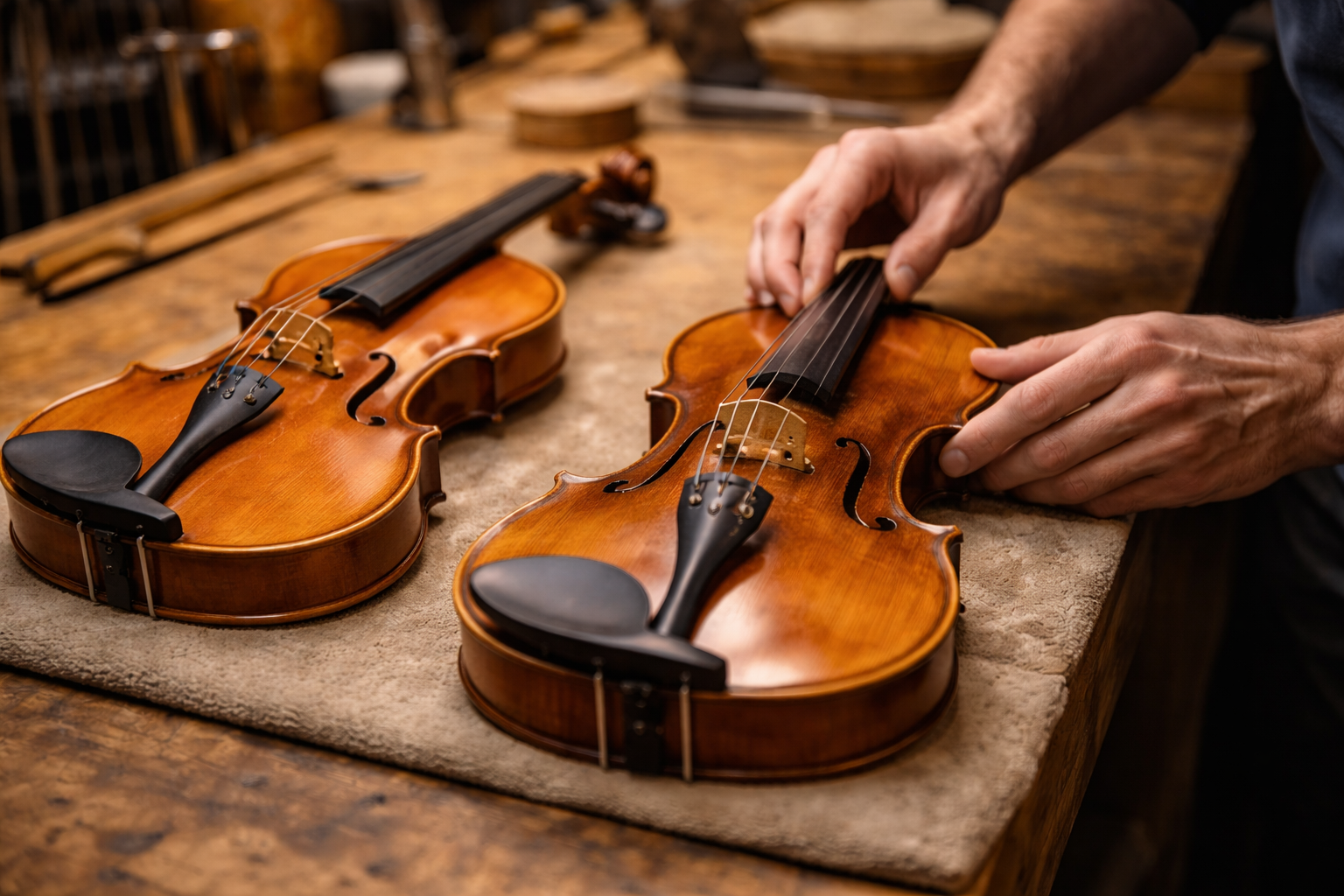
When shopping for a violin, especially as a parent of a new student or an adult beginner, one of the most confusing questions is the difference between a factory-made instrument and a handmade or benchmade instrument. Both types exist for a reason, both can be playable, and both appear at very different price points. Understanding what those terms really mean can help you compare instruments more fairly and feel confident about what you are buying.
At Von’s Violin Shop, customers often come in having seen both types online or at other stores, and they want to understand why one violin might cost a few hundred dollars while another costs several thousand. The difference is not just about brand names or labels. It comes down to how the instrument is built, how it is finished, and how it ultimately sounds and responds to the player.
What “Factory-Made” Really Means
A factory-made violin is produced in a workshop or factory setting where many instruments are made at the same time in an assembly line process. Different parts of the violin are often made by different workers, sometimes using machines for cutting and shaping. The goal is consistency and efficiency.
In many factory environments, the top, back, ribs, and necks are carved to standard measurements. Assembly follows a set pattern, and finishing work such as varnish is often applied quickly so the instrument can move through production. This does not automatically make the violin bad. Many factory-made violins are perfectly suitable for beginners, especially when they are properly set up and adjusted.
However, factory-made instruments are built to be uniform rather than individually optimized. Wood selection is done in batches rather than piece by piece, and fine adjustments to thickness, arching, or graduation are limited. Because of this, factory-made violins tend to have a narrower sound range and less responsiveness, even when they are well made.
What “Handmade” or “Benchmade” Means
A handmade or benchmade violin is built primarily by one maker or a very small number of makers working at a bench. Instead of following a production line, the luthier works with each piece of wood individually. The maker evaluates how the wood feels, how it flexes, and how it responds as the instrument takes shape.
This approach allows for far greater control over the violin’s tone and playability. Thicknesses are adjusted based on the specific wood being used, not just a template. Arching is refined by hand. The soundpost and bass bar are fit with precision to support the instrument’s natural resonance.
At Von’s Violin Shop, the focus is on these handmade instruments because of the level of care and musical potential they offer. While this process takes more time, the result is an instrument that is more responsive to the player and capable of developing a richer sound over time.
Why Handmade Violins Cost More
The most obvious difference between factory-made and handmade violins is price. Handmade instruments cost more because they require far more skilled labor and time. A benchmade violin can take hundreds of hours to complete. Every stage of construction requires judgment and experience, not just repetition.
In addition, higher-quality materials are usually involved. Wood for handmade violins is carefully selected, often aged longer, and chosen for its acoustic properties rather than availability. The varnish is typically applied by hand in thin layers, which allows the wood to vibrate more freely.
You are not just paying for the instrument itself. You are paying for the maker’s experience, their ear, and their ability to bring out the best sound possible from the materials. This is why handmade instruments are more expensive, and why that cost is justified for players who are ready to hear and feel the difference.
How the Difference Feels to a Player
For beginners, the difference between factory-made and handmade violins may not be obvious right away. However, as soon as a player starts to develop bow control and intonation, the instrument’s response becomes very noticeable.
A handmade violin tends to speak more easily. It responds to lighter bow pressure, produces a clearer tone across strings, and offers a wider range of dynamics. This makes learning easier and more enjoyable, especially for adult beginners who are sensitive to tone quality.
Factory-made violins can feel stiffer and less forgiving. They may require more effort to produce a clean sound, which can be frustrating as skills develop. This does not mean they are unusable, but it does mean they have limits.
Comparing Instruments Fairly
When comparing violins, it is important to compare them in the same environment, with proper setup, and ideally with guidance. A poorly set up handmade violin can sound worse than a well set up factory instrument. That is why professional evaluation matters.
At Von’s Violin Shop, customers are encouraged to play instruments side by side and take their time listening to differences. The goal is not to push someone into a higher price range, but to help them understand what they are hearing and feeling.
Which Is Right for You?
Factory-made violins often make sense for rentals, short-term needs, or very early beginners. Handmade violins are better suited for players who plan to continue, develop their sound, and grow with their instrument.
Von’s Violin Shop focuses on handmade violins because they offer long-term value, musical depth, and a more satisfying playing experience. For rentals and student programs, customers are directed to Northland Violins, where factory-made instruments are appropriately matched to those needs.
If you are unsure which type of violin is right for you or your child, the best step is to ask questions and play instruments in person. Comparing fairly starts with understanding how the instrument was made and what that means for sound, feel, and future growth.
If you would like help comparing instruments or understanding what you are hearing, you are always welcome to speak with the staff at Von’s Violin Shop.