



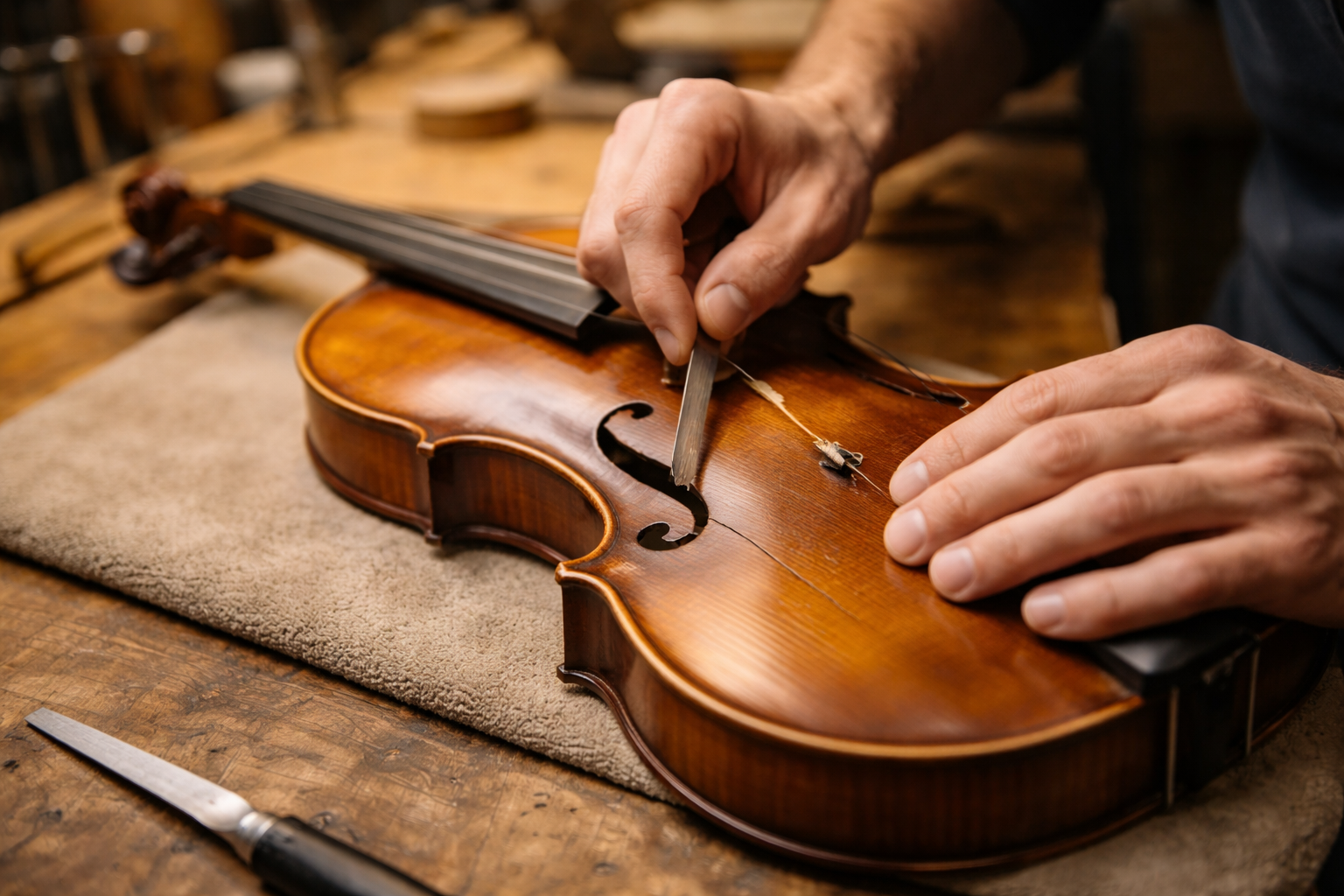
For parents and new players, discovering a crack or an old repair on a violin, viola, cello, or bass can be alarming. It is natural to wonder whether the instrument is damaged beyond use, whether it is safe to play, or whether it is even worth fixing. The truth is that not all cracks are equal, and not all repairs are a cause for concern. Understanding the difference between cosmetic issues and structural problems can help you make informed decisions without unnecessary worry.
At Von’s Violin Shop, instruments offered for sale do not have unresolved structural damage. However, many people come in with instruments they already own, sometimes inherited or purchased elsewhere, and want to know what they are looking at. This guide is meant to help you understand what matters, what does not, and when professional evaluation is essential.
First, What Is a Crack?
A crack is a separation in the wood of the instrument. Because violins, violas, cellos, and basses are made from thin, carefully carved pieces of wood, they can crack due to changes in humidity, accidental impact, or long-term stress. Cracks can occur on the top, back, ribs, or near areas under tension such as the soundpost or neck.
Some cracks are relatively minor and repairable. Others are more serious and affect the structural integrity of the instrument.
Cosmetic vs Structural Issues
One of the most important distinctions is between cosmetic flaws and structural problems.
Cosmetic issues include surface scratches, worn varnish, small edge chips, or old finish touch-ups. These do not affect how the instrument plays or sounds. They may change how the instrument looks, but they are not dangerous or harmful.
Structural issues involve the wood itself. Cracks that go through the wood, open seams where glued joints have separated, or poorly executed repairs fall into this category. These issues require professional attention.
Location Matters More Than Size
When it comes to cracks, where the crack is located matters more than how long it is.
Cracks along the ribs or near glued seams are often repairable and relatively common, especially on older instruments. Cracks in low-stress areas can sometimes be stabilized effectively by a skilled luthier.
Cracks in high-stress areas are more serious. These include cracks near the soundpost, bass bar, neck joint, or saddle. Because these areas handle significant tension, repairs must be done correctly or the instrument can suffer further damage.
A properly repaired crack in a critical area can still result in a healthy, playable instrument, but it requires expert work.
Old Repairs Are Not Automatically Bad
Many parents are surprised to learn that fine instruments, including those that are hundreds of years old, often have repairs. Wood moves over time, and instruments that have been played for generations may show evidence of past work.
A well-executed repair, done by a skilled luthier, can be stable and reliable for decades. In some cases, repaired cracks have no noticeable impact on sound or playability.
What matters is not whether a repair exists, but whether it was done correctly.
Warning Signs of Poor Repairs
There are signs that a repair may be problematic. These include visible glue residue, uneven surfaces, misaligned wood grain, or cracks that appear to be reopening. Repairs that were rushed or done by someone without proper training can cause more harm than good.
If an instrument shows signs of an amateur repair, it should be evaluated by a professional before being played further.
Why Value Matters in Repair Decisions
Whether a crack makes an instrument “not worth repairing” often depends on the instrument’s underlying quality. Student instruments that were inexpensive to begin with may not justify the cost of complex structural repairs. In those cases, repair costs can exceed the instrument’s value.
On the other hand, higher-quality instruments, including fine or historical instruments, can justify extensive repair work. A well-made instrument retains value even after professional repairs, provided the work is done correctly.
This is one reason Von’s Violin Shop does not sell damaged instruments. Any instrument offered for sale meets professional standards of structural integrity and setup.
Differences Across Instruments
While the principles are similar across violin, viola, cello, and bass, larger instruments like cello and bass experience greater tension. Cracks on these instruments may require more extensive reinforcement. That does not automatically make them worse, but it does make professional evaluation even more important.
Why Professional Evaluation Is Essential
Cracks and repairs are not something that can be fully assessed by appearance alone. What looks minor on the surface can be more complex underneath, and what looks alarming may be completely manageable.
At Von’s Violin Shop and Northland Violins, luthiers are trained to assess instruments carefully and honestly. If an instrument is repairable, they can explain what work is needed and why. If it is not worth repairing, they will say so plainly.
A Calm, Informed Approach
Finding a crack does not mean panic is warranted. Many cracks are repairable, and many repaired instruments continue to be played safely and beautifully. The key is understanding the difference between harmless wear and serious structural damage.
If you have an instrument with a crack or an old repair, whether it is one you already own or one you are considering elsewhere, bringing it to Von’s Violin Shop for evaluation can provide clarity and peace of mind. Asking questions and learning what you are seeing is always the right first step.