



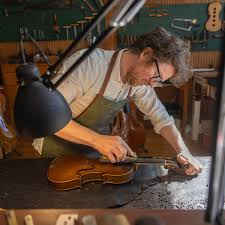
When people search for “luthiers near me,” they’re often facing an important moment: an instrument needs repair, evaluation, or expert care, and they want to make sure it’s handled by someone who truly understands it.
At Von’s Violin Shop, luthiers are at the heart of everything we do. But what exactly is a luthier—and what do they actually do?
What Is a Luthier?
A luthier is a craftsperson who builds, repairs, restores, and sets up string instruments. While the word originally referred to makers of lutes, today it applies broadly to stringed instruments of any kind. However, there is an important distinction:
Not all luthiers work on the same kinds of instruments.
At Von’s Violin Shop, our luthiers specialize in orchestral string instruments, including:
- Violins
- Violas
- Cellos
- Double basses
- Instrument Bows
These instruments require specialized knowledge that goes far beyond general woodworking or instrument repair.
A Brief History of the Luthier’s Craft
The craft of luthiery dates back centuries, with roots in medieval Europe. Early luthiers were both artists and engineers, experimenting with shape, wood selection, and construction methods to improve tone and projection.
By the 16th and 17th centuries, luthiery had become a highly refined trade, particularly in regions like Cremona, Italy. Names such as Stradivari, Amati, and Guarneri are still referenced today—not because modern luthiers copy them exactly, but because they established principles of sound and structure that still guide the craft.
Traditionally, luthiers learned through apprenticeship, working for years under a master before practicing independently. While modern tools and materials have evolved, the core principles of the craft remain deeply rooted in history.
What Does a Modern Luthier Do?
Today, a luthier’s work typically falls into four main areas:
1. Instrument Evaluation
A luthier examines an instrument to assess:
- Structural integrity
- Setup and playability
- Existing or hidden damage
- Overall value and repair potential
This evaluation determines whether an instrument needs adjustment, repair, restoration—or whether it’s even worth repairing at all.
2. Setup and Adjustment
Proper setup is essential for sound and comfort. This includes:
- Bridge fitting and adjustment
- Soundpost placement
- String selection and installation
- Fingerboard and nut shaping
Even a well-made instrument can be difficult to play without proper setup.
3. Repair and Restoration
Luthiers repair damage caused by age, climate, accidents, or wear. Common repairs include:
- Open seam regluing
- Crack repair
- Peg fitting
- Fingerboard planing
- Structural reinforcement
Restoration work on older instruments requires especially careful judgment, balancing preservation with playability.
4. Instrument Making (in some cases)
Some luthiers also build instruments from raw wood, a process that can take hundreds of hours. While not all luthiers are makers, the skills involved in building inform how repairs are done.
What It Takes to Become a Luthier
Becoming a luthier is not a quick process. It requires years of focused training and experience.
Step 1: Foundational Skills
Aspiring luthiers often begin with:
- Woodworking fundamentals
- Understanding of acoustics
- Musical knowledge (many luthiers play string instruments themselves)
Step 2: Formal Education or Apprenticeship
Many luthiers attend specialized violin-making schools or train through long-term apprenticeships. This stage focuses on:
- Instrument construction techniques
- Traditional hand tools
- Repair methods
- Materials science (woods, glues, varnishes)
Step 3: Years of Practical Experience
Even after formal training, a luthier continues learning through real-world repairs. Experience teaches how instruments behave over time and how subtle changes affect sound.
Step 4: Mastery Through Practice
The term “Master Luthier” is not a casual title. It reflects extensive experience, consistency, and judgment developed over many years of hands-on work.
Why “Luthiers Near Me” Matters
String instruments are sensitive to climate, handling, and setup. Having a local luthier matters because:
- Instruments can be evaluated in person
- Adjustments can be tailored to the player
- Communication is clear and direct
- Ongoing care is accessible
Online purchases and distant repairs often miss the nuances that only an in-person evaluation can reveal.
Honesty Is Part of the Craft
One of the most important roles of a luthier is knowing when not to repair an instrument.
Some instruments—sometimes referred to as violin-shaped objects—are poorly constructed and not worth the cost of repair. A professional luthier will tell you this honestly, even if it means recommending a different path.
Our priority is always giving customers accurate information so they can make informed decisions.
Why Trust Von’s Violin Shop
At Von’s Violin Shop, our luthiers work exclusively with orchestral string instruments. We combine historical knowledge, modern technique, and clear communication to serve musicians at every level—from first-time students to experienced players.
Bring It In — We’re Here to Help
If you have an instrument—whether it’s one you play every day or one that’s been stored away for decades—bring it in.
One of Von’s Violin Shop’s Master Luthiers will evaluate it at no charge, explain what it needs, what it will cost, and how long it will take. If it isn’t worth repairing, we’ll tell you that honestly.
Any work we preform we stand behind, we’re here and have been for decades standing behind our work and reputation.
That’s what you should expect when searching for luthiers near you.